
Are You Still Mad?
It's Time to Let It Go
Resentments can fester for years, making you angry and bitter.
Forgiveness can help you release the past by choosing your well-being above your sense of righteous indignation.
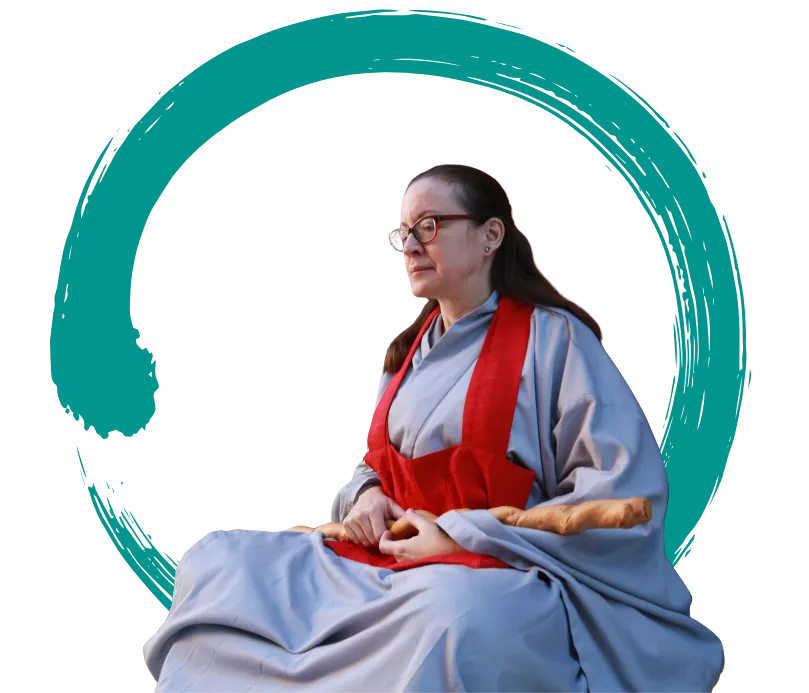
Schedule an appointment with Sandy Myodo Gougis, Forgiveness Coach and Zen Master. Learn to put it all down and move forward with grace and ease.

Let it all go...
Most people think forgiveness is a decision - something you do once. You make a decision and that's that.
But if the process were that simple, you'd be done with it by now.
Resentment, anger, and grief live in the mind and body long after we recognize them intellectually.
Awareness alone rarely releases them. And contrary to greeting card sentiments, time does not heal all wounds.
Forgiveness becomes complete only when practiced.
Luckily, there are meditation and mindfulness tools that make forgiveness possible by gently loosening the emotional patterns that keep the past alive.
With practice, something remarkable happens: the grip of old stories softens, the emotional charge fades, and space opens where tension once lived.
Peace - calm, steady, nurturing - begins to take its place.

Some wounds don’t fade with time.
You may have tried to move forward. You may have told yourself that it "shouldn’t" matter anymore.
Yet something remains: a conversation you replay, a betrayal you still think about, or a weight that follows you into quiet moments.
Resentment is not simply a memory. It becomes a pattern held in the mind, the heart, and even the body.
Forgiveness is not about pretending the past didn’t happen. It's about freeing yourself from the hold it still has on you.
This is where the practice begins.

Forgiveness is not a single decision. It is a practice.
Most people are told to forgive, but few are shown how.
At Profound Way, forgiveness is approached as a steady, practical process supported by meditation and mindful awareness.
You learn to:
• calm the nervous system when painful memories arise
• observe resentment without being consumed by it
• soften the inner narratives that keep old wounds alive
• gradually release the emotional weight you have carried
These are not abstract ideas. They are simple practices you can return to whenever you need.
With time, what once felt impossible becomes natural.
And something unexpected happens: The past loses its grip.
Be part of a community
If you are carrying something that feels difficult to release, you are not alone.
Many times it's easier to do the work of personal growth alongside others.
Just seeing that there are other people in similar situations is a huge benefit.
And helping others helps us heal ourselves.

How forgiveness became the work
Most people come to forgiveness the hard way.
For many of us, it isn't an abstract idea or a spiritual ideal.
It's a necessity, because holding on begins to cost too much.
At some point, I realized that forgiveness was not something that simply happens with time. It is something we learn to practice slowly, deliberately, and often imperfectly.
Meditation and mindfulness became the tools that made this possible for me. They created space between the wounds of infidelity & divorce and the story I was carrying about it. They allowed my nervous system to settle. In that quiet space, something began to shift.
Forgiveness didn't erase my past, but it did change my relationship to it.
That discovery became the foundation of the Way of Forgiveness - a method devoted to the courageous work of letting go.

The Practice of Forgiveness
The Way of Forgiveness guides you through the process with practices to support your growth:
Meditation
See your patterns clearly, without judgment. Learn to observe thoughts and emotional patterns without immediately reacting to them.
Use meditation and breath-based practices to calm the mind and soothe the nervous system when painful memories arise.
Journaling
Write without censorship. Let what's on your heart move out of your body and onto the page.
Guided prompts will help you tell your story. Of course, you can write about additional things, too.
Art
Or "art," to be more accurate. It's not about creating a masterpiece. It's about expressing yourself in a way that doesn't require words.
Maybe you like to draw, doodle, or work with clay. Perhaps you're drawn to performing arts, like dancing and singing.
Unleash your inner child and play. See what reveals itself.
A quiet place to reflect

The path of forgiveness is rarely a straight line. Some days feel spacious and clear. Others bring old memories back to the surface.
When that happens for me - I write about it.
Read my essays in my Substack publication, After the Hurt. I write about forgiveness, healing, and rediscovering ourselves.
You can read on the Substack app or on the website, or you can subscribe to receive After the Hurt in your inbox.
You can also comment and chat to make connections with me and others.
Forgiveness isn't what you think
Many people resist the idea of forgiveness because they've been taught a version of it that feels impossible, or even harmful.
But forgiveness is not what most people think it is.
Forgiveness is not any of these:
Forgetting
The past does not disappear simply because you decide to forgive. Memory remains. Experience remains. Forgiveness changes the weight those memories carry.
Excusing Harm
Recognizing that something was wrong is often the first step toward healing. Forgiveness does not deny harm - it releases the hold that harm continues to have over your life.
Reconciliation
You may forgive someone and still choose not to continue a relationship. Healthy boundaries are often part of the process. Forgiveness is not permission.
Instead, forgiveness is an act of healing. We forgive other people for our own sake's, not for theirs. In many cases they do not know whether we have forgiven them, and they do not care.
Forgiveness allows you to loosen the grip of resentment, anger, and rumination so that the past no longer dominates the present.
It is not a single moment of decision.
It is a practice that unfolds over time.
And Now for Some Science
Unforgiven experiences keep your nervous system on high alert.
Your brain continues to replay events, and your body remains subtly vigilant. Resentment isn't just psychological, it is physiological.
When you hold a painful experience in your memory without resolution, your body often continues to respond as if the event is still happening.
Thoughts return to the event, reactivating your emotions. Your nervous system reacts to the memory as a current, stressful event, and enters the "fight or flight" state.
Forgiveness gradually allows your nervous system to return to the "rest and digest" state.
The Way of Forgiveness creates the conditions where your body can begin to relax. As your mind becomes calmer and more spacious, the emotional charge surrounding the past gradually dissipates.
Your past is still your past, but your body no longer needs to defend against it in the present.
Over time, forgiveness emerges, rather than being forced.
You don’t have to carry it forever
Most people learn to live with the weight of old wounds.
They move forward, build lives, raise families, cultivate careers. Yet something inside remains unresolved.
Forgiveness offers another path.
It isn't a sudden transformation or a demand to feel differently overnight. It's a quiet practice that gradually loosens the past from the present.
If you are ready to begin that process, please accept my gift to you:
Download Forgiveness: How to Release Resentments Without Losing Yourself and take the first step toward a lighter mind and heart.
Land Acknowledgement
We acknowledge that we live and work on the unceded, traditional territories of the Tongva and Coast Salish peoples (currently known as Southern California and Southern British Columbia respectively). We offer our respect to these First Nations and their enduring legacies, as well as their elders past, present, and emerging.


Quick links
© Sandra Gougis. 2026. All Rights Reserved.